
Brazil Strengthens Grip On Global Cotton Trade As India’s Imports Rise
USDA
raises global production and trade forecasts for 2026-27, while Brazil
consolidates its position as a major supplier. India’s cotton imports are
projected to rise as mills take advantage of the temporary duty waiver.
Brazil
is tightening its grip on the global cotton trade. The country is expected to
export a record 16 million bales in 2026-27, marking the fourth consecutive
year of record shipments, as higher production strengthens its position in
international markets. At the same time, India and Vietnam are emerging as
larger import buyers, according to the US Department of Agriculture's October
report, Cotton: World Markets and Trade.
Global
cotton production is forecast at 118 million bales for 2026-27, up more than
600,000 bales from the previous estimate. The increase is largely driven by
Brazil and the US, offsetting a smaller crop in Argentina. Brazil's production
estimate has been raised by 500,000 bales to 19 million, reflecting improved
yields. US production is also revised upwards to 13.44 million bales.
Global
cotton trade is projected to increase by nearly 500,000 bales to 44.7 million.
Brazil's exports account for much of the upward revision, rising by 500,000
bales to 16 million. Its growing export availability is reshaping sourcing
patterns in several major textile-producing countries.
India's
imports move higher
India's
cotton imports for 2026-27 have been raised by 300,000 bales to 3.3 million.
The USDA attributes the increase to mills taking advantage of the temporary
suspension of import duties during August, September and October.
India's
domestic cotton consumption is forecast at 26.5 million bales, against
production of 24 million bales. Exports are projected at 1.5 million bales,
while ending stocks are estimated at 10.43 million bales. The import forecast
underlines the importance of overseas supplies in meeting mill requirements.
Vietnam's
imports have also been raised by 100,000 bales to 8.3 million, reflecting
higher consumption. Global cotton consumption is forecast at 123.1 million
bales, up nearly 200,000 bales from the previous estimate, with higher use
projected in Guatemala, Malaysia and Vietnam.
Turkey
turns increasingly to Brazil
The
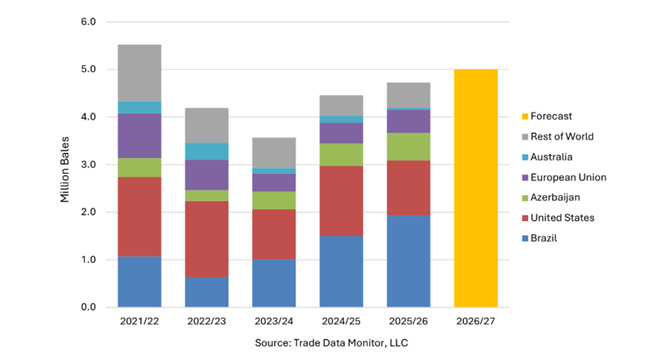
report highlights a significant shift in Turkey's cotton sourcing. Brazil
overtook the US as Turkey's leading cotton supplier in 2024-25, as Turkish
mills increasingly turned to competitively priced Brazilian and nearby
Azerbaijani cotton.
Turkey's
cotton imports are forecast at 5 million bales in 2026-27, making it the
world's fifth-largest importer. Imports are expected to rise as the country
offsets lower domestic production, estimated at 2.4 million bales. Domestic
consumption is forecast at 6.8 million bales, unchanged from the previous year.
However,
Turkey's textile and apparel industry continues to face pressure from high
inflation and energy costs, which have raised operating expenses. Mills are
looking for lower-cost cotton to remain competitive.
Turkey's
own cotton exports are forecast to fall nearly 50% to 600,000 bales because of
reduced supplies. The European Union, Bangladesh and India remain among its key
markets. Weaker EU orders and growing competition from China, Pakistan,
Bangladesh and Vietnam are also weighing on Turkish textile exports. Lower
domestic purchasing power has further affected demand for cotton products,
particularly garments. Mills are reporting reduced capacity utilisation, with
some facilities closing or relocating to lower-cost production bases.
Prices
ease across major markets
Cotton
prices have weakened since the previous USDA report. ICE cotton futures fell by
around 8 cents to approximately 80 cents per pound.
Between
September 8 and October 6, the Cotlook A-Index declined 4.5 cents to 91.5 cents
per pound. India's Shankar-6 spot price fell 6.3 cents to 86.5 cents, while
China's benchmark declined 6.1 cents to 116.6 cents. Brazilian and Pakistani
prices also moved lower.
Global
ending stocks are forecast to increase by more than 800,000 bales to 70.7
million, with higher stocks in India, the US and Uzbekistan contributing to the
rise. The USDA has also lowered its forecast for the US 2026-27 season-average
farm price by 1 cent to 77 cents per pound.
The
October outlook points to a market with greater export availability,
particularly from Brazil, and stronger import demand in key textile-producing
countries. For mills, sourcing decisions will increasingly depend on the
relative cost and availability of cotton from competing origins, alongside
currency movements and freight costs.
The October outlook points to a market with greater export availability, particularly from Brazil, and stronger import demand in key textile-producing countries. For mills, sourcing decisions will increasingly depend on the relative cost and availability of cotton from competing origins, alongside currency movements and freight costs.
Subscribe To Textile Excellence Print Edition
If you wish to Subscribe to Textile Excellence Print Edition, kindly fill in the below form and we shall get back to you with details.
Newsletter
Subscribe To Textile Excellence Mailing List


- December 09, 2022
'There Is Very High Acceptance For India

- December 09, 2022
'Advanced Machines & Service, Customer C

- October 09, 2023
First-time In The World: Rieter’s Auto

- July 28, 2026
Arvind Eyes Leadership In India's Premiu

- June 01, 2020
Karl Mayer Enables Automated Production

- June 05, 2023
Ultimax - All New Revolutionary Rapier W

- June 09, 2025
DyStar Becomes A Wholly Owned Subsidiary

- July 28, 2026