
TMAS Technology Behind The Perfect Little Black Dress
The little black dress may be one of fashion’s simplest and most
enduring garments, but achieving its characteristic clean lines depends on
manufacturing precision of the kind supplied by Swedish textile machinery
specialist and TMAS member Svegea.
Ever since Audrey Hepburn appeared in Givenchy’s celebrated
creation in Breakfast at Tiffany’s, the Little Black Dress (LBD) has
become a wardrobe staple across generations. Its appeal lies partly in its
apparent simplicity, but producing a dress that retains its shape, sits cleanly
around the neckline and withstands repeated wear requires considerable
attention to details that are largely invisible to the wearer.
One of those details is bias binding.
Bias binding is produced from strips of fabric cut diagonally
across the material rather than along its straight grain. Cutting on the bias
gives the strip greater flexibility, allowing it to follow curved necklines,
armholes and other edges without puckering or distorting the garment.
It can be used to enclose raw edges, reinforce areas subjected to
movement and provide a clean internal finish. While largely unnoticed by the
wearer, accurately produced and applied binding can consequently make an
important contribution to both the appearance and durability of a garment.
For a home sewer, bias strips can be cut and prepared manually but
in industrial garment production, where thousands of identical pieces may be
required, the challenge is quite different.
Consistency of width and cut becomes critical, while manufacturers
must also control material use and maintain production speeds. It is here that
TMAS member Svegea has established a specialist position with automated
equipment for bias binding and other fabric cutting operations.
From roll to binding
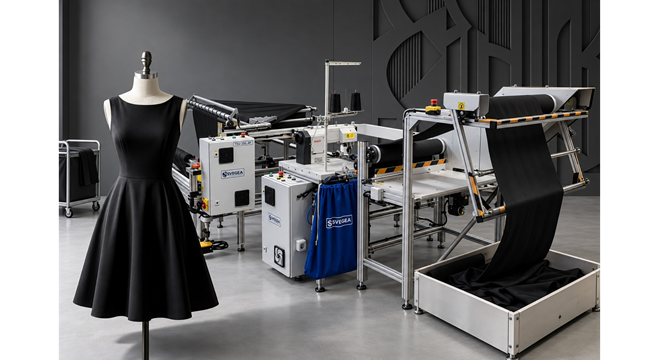
Svegea’s system is designed to convert fabric rolls into
continuously produced bias material in a series of automated operations.
The process begins with the company’s Tube Sewing Unit, which
joins open-width fabric to create a continuous tube. This is subsequently
handled by the Bias Cutter and Winder, opening and rewinding the material in
preparation for accurate slitting.
The equipment can produce narrow strips down to 6mm as well as
wider bindings required for heavier fabrics and more structural applications.
Automating these operations enables garment manufacturers to
maintain consistent dimensions over long production runs while reducing the
variations that can arise when material is prepared manually.
This consistency becomes particularly important where binding has
to follow prominent curved areas of a garment. A neckline or armhole that does
not sit correctly can immediately affect the appearance and fit of an otherwise
well-made product.
The little black dress provides an obvious example. With few
patterns or decorative elements to distract the eye, construction details and
the quality of the finish become particularly important.
Beyond the LBD
The applications for industrial bias cutting extend considerably
beyond dresses.
Bias binding is widely employed in blouses, childrenswear,
activewear and other garments requiring flexible edge finishing, as well as in
bags, accessories and home textile products.
Svegea has developed its machinery around these varied production
requirements, with equipment for bias cutting complemented by collarette
cutters for applications such as waistbands and roll slitters for handling
larger fabric rolls.
The common requirement is repeatability. As garment production has
become increasingly automated, processes that once depended heavily on manual
skill have progressively been engineered to deliver consistent results at
industrial volumes.
This is also representative of the highly specialised areas in
which Swedish textile machinery companies continue to operate.
The common requirement is repeatability. As garment production has become increasingly automated, processes that once depended heavily on manual skill have progressively been engineered to deliver consistent results at industrial volumes. This is also representative of the highly specialised areas in which Swedish textile machinery companies continue to operate.
Subscribe To Textile Excellence Print Edition
If you wish to Subscribe to Textile Excellence Print Edition, kindly fill in the below form and we shall get back to you with details.
Newsletter
Subscribe To Textile Excellence Mailing List


- December 09, 2022
'There Is Very High Acceptance For India

- December 09, 2022
'Advanced Machines & Service, Customer C

- October 09, 2023
First-time In The World: Rieter’s Auto

- July 28, 2026
Arvind Eyes Leadership In India's Premiu

- June 01, 2020
Karl Mayer Enables Automated Production

- June 05, 2023
Ultimax - All New Revolutionary Rapier W
- June 09, 2025
DyStar Becomes A Wholly Owned Subsidiary

- July 28, 2026