
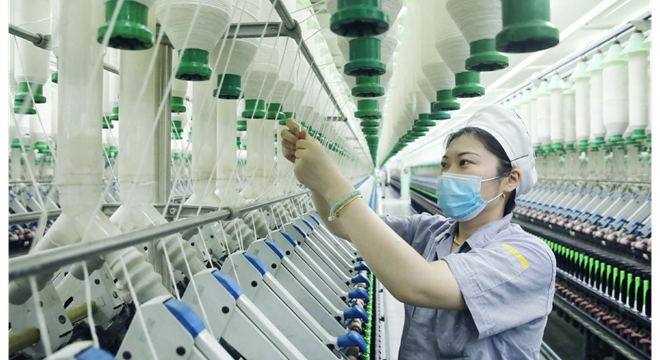
China Wants Its Textile Industry To Get Smarter, Greener And More Valuable
China has set its textile
and light industry machine rolling into a new gear.
Its new 15th Five-Year Plan
for Light Industry and Textiles, released on September 22, targets operating
revenue of more than RMB 30 trillion for above-designated-size companies by
2030. But the bigger story is what China wants to do with that enormous
industrial base.
The plan puts AI, green
manufacturing, recycling, innovation, branding and higher-value textile
applications at the centre of the next five years.
The scale is already
enormous
China is trying to upgrade its
industry, one that already dominates global manufacturing.
By the end of 2025,
above-designated size companies in light industry and textiles accounted for
34.5% of all industrial enterprises in China, 19.8% of industrial operating
revenue, 20.8% of industrial profits and 32% of total industrial exports,
according to the Ministry of Industry and Information Technology (MIIT).
The new plan therefore
marks a shift from simply maintaining scale to improving productivity,
technology, value creation and global value-chain position.
China has set 11 targets
covering scale and efficiency, innovation, transformation, industrial clusters
and employment. By 2030, it wants the sector to become significantly more
intelligent, green and integrated.
AI moves onto the factory
floor
AI is no longer being
treated as a futuristic add-on.
The plan calls for
industry-specific large models and AI agents covering the entire light-industry
and textile value chain. It also wants industries to identify specific AI
application scenarios and develop digital tools and solutions around them.
For textiles, that opens
the door to AI across design, product development, production planning, quality
inspection, process optimisation, energy management and supply chains.
And China is not stopping
at software. The plan calls for AI-related standards, certification and
labelling for key sectors.
Green is becoming
industrial policy
China also wants textile
manufacturing to become substantially greener.
The plan calls for stronger
controls on energy, water consumption and pollutant emissions, green product
design and cleaner energy substitution. It specifically calls for action in
sectors including chemical fibre.
But the more interesting
move is towards a circular textile system.
China plans to establish
resource utilisation centres for waste textiles, improve social collection
channels and build a more standardised recycling system for used textiles.
That could eventually have
implications far beyond China’s domestic market, particularly for companies
supplying global brands that increasingly need recycled content and
traceability systems.
600 standards are on the
table
China also wants to tighten
the rulebook around its industrial upgrade.
The plan calls for more
than 30 mandatory national standards and roughly 600 urgently needed industry
standards to be formulated or revised.
It also plans standards and
certification for AI applications in key light-industry and textile sectors.
That is a significant
number and potentially significant work for machinery makers, fibre producers,
chemical companies, manufacturers and testing organisations.
Textiles are being pushed
into new markets
Perhaps the most
interesting part of the plan is the attempt to move textiles beyond
conventional apparel and home textiles.
China wants to develop 10
categories of innovative textile products and is targeting eight areas
including baby and children's products, youth products, fashion products,
elderly products, maternity products, specialised occupational and regional
products, pet products and production-service products.
It also launches a proposed
“Textile+” approach, pushing textile technologies into healthcare, construction
and geotechnical applications, marine engineering, electronics and new energy.
That means more attention
to technical textiles, advanced materials and cross-industry applications.
China's next textile push
is not simply about making more fabric or garments.
It is about making them
smarter, cleaner, more specialised and more valuable.
For competing
textile-producing countries, the interesting question over the next five years
will therefore not just be how much China produces.
It will be how quickly
China's enormous manufacturing base can turn AI, recycling, advanced materials
and higher-value products into commercial advantages.
For competing textile-producing countries, the interesting question over the next five years will therefore not just be how much China produces. It will be how quickly China's enormous manufacturing base can turn AI, recycling, advanced materials and higher-value products into commercial advantages.
Subscribe To Textile Excellence Print Edition
If you wish to Subscribe to Textile Excellence Print Edition, kindly fill in the below form and we shall get back to you with details.
Newsletter
Subscribe To Textile Excellence Mailing List


- December 09, 2022
'There Is Very High Acceptance For India

- December 09, 2022
'Advanced Machines & Service, Customer C

- October 09, 2023
First-time In The World: Rieter’s Auto
- July 28, 2026
Arvind Eyes Leadership In India's Premiu
- June 01, 2020
Karl Mayer Enables Automated Production

- June 05, 2023
Ultimax - All New Revolutionary Rapier W
- June 09, 2025
DyStar Becomes A Wholly Owned Subsidiary

- July 28, 2026